
Lifting safety – planning, responsibilities, and documentation
1/9/2026
Introduction
Lifting operations are inherently high-risk, but when properly planned and led, they can be safe and efficient. In Finland, lifting work is governed by the Occupational Safety and Health Act (738/2002), Government Decree 403/2008 on the safe use and inspection of work equipment, and Government Decree 205/2009 on the safety of construction work. These require identifying hazards, providing personnel induction/training, using equipment according to the manufacturer’s instructions, and documenting inspections.
1) Lift plan: when it is required
Prepare a lift plan whenever the lift is demanding, involves a two-crane tandem lift (multiple cranes operating simultaneously), or when the lifting route and load control require exceptional coordination. The regulation specifically requires a written plan for tandem lifts; weather conditions (such as freezing temperatures or crosswind) do not, by themselves, create a mandatory planning requirement—although they may affect safe execution and stop limits.
Core contents of the plan (briefly):
- Load: weight, center of gravity, lifting points, route.
- Method and lifting accessories: sling angles, WLL markings, protection against sharp edges.
- Positioning and setup: ground bearing capacity, outrigger pads/cribbing.
- Exclusion zones: isolating the lifting area and preventing access.
- Communication: hand signals and radio rules (dedicated/closed channel for lift control).
- Emergencies and stop limits: managing deviations; synchronization criteria in tandem lifts.
2) Responsibilities and qualifications
- The principal contractor and safety coordinator are responsible for overall safety on a shared site: induction, instructions, and supervision.
- The lifting supervisor coordinates the lifts, reviews the plan, and ensures communications are in place (signal person/radio channel).
- Operator competence and written authorization: certain cranes require a vocational qualification (mobile crane >5 t, tower crane >25 tm, loader crane used for installation work >25 tm). The employer’s written authorization is required, among other things, for attaching the load to a crane intended for installation work.
3) Work equipment, radio traffic, and lifting accessories
- Selection and condition: equipment is selected for the conditions and used according to the manufacturer’s instructions. WLL markings and the condition of lifting accessories are verified before use.
- Radio traffic: the radio channel used for lift control is reserved for lifting operations only; this is especially critical in a two-crane tandem lift to ensure synchronization.
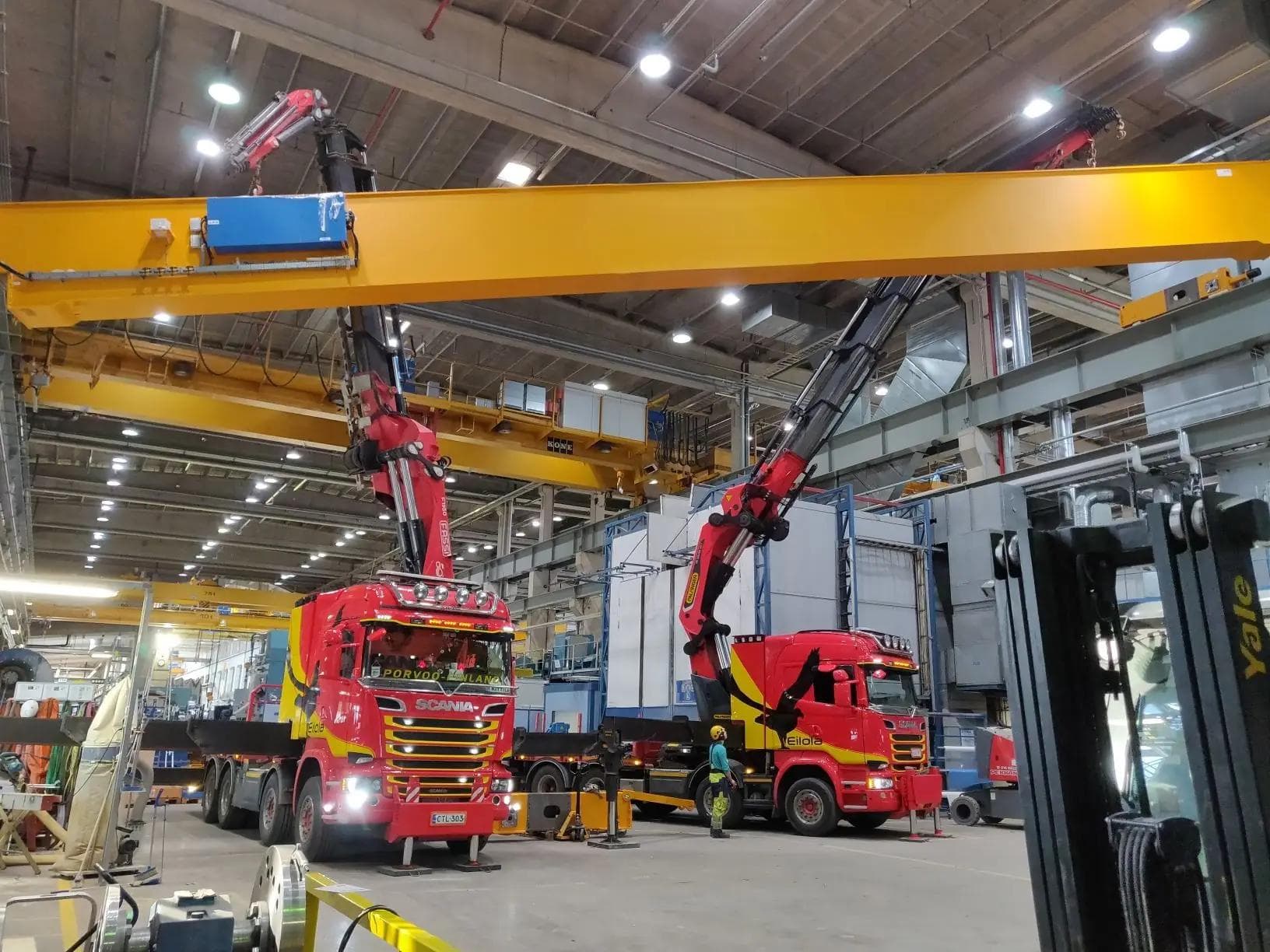
4) Two-crane tandem lift (tandem lift)
When a load is lifted simultaneously by two cranes, a written lift plan must be prepared. The plan defines roles and responsibilities (one lead signal person/coordinator), load sharing (percentages and angles), synchronization and radio communications (commands and pacing), and stop limits (e.g., dynamic deviations).
5) Inspections and documentation
- Commissioning inspection (pre-use): carried out by an approved expert/expert organization before commissioning; documentation is mandatory.
- In-service inspections: daily and weekly (functional checks: brakes, safety devices, outriggers). Inspections are recorded as a log, minutes, or other stored record.
- Periodic inspection: at least annually; documentation is archived.
Installation crane setup record: what it is and when it is required
An installation crane setup record is a site-specific written document used to ensure and verify that the crane’s erection/positioning and foundation/support have been completed safely before lifting work begins. It complements the commissioning inspection and the documentation of daily/weekly inspections.
A setup record is made:
- Before the first lift at each new setup location, or whenever the crane is moved to a new position on site.
- Whenever conditions change materially (foundation/support/exclusion zones), or when moving to a two-crane tandem lift.
6) Safety = reliability and cost efficiency
- Fewer stoppages: a dedicated radio channel and tandem-lift coordination reduce erroneous commands and dynamic overloads.
- Less rework: correctly sized accessories and documented inspections prevent damage.
- Better schedule adherence: proactive risk management and clear responsibilities reduce the likelihood of deviations and shorten lead time.
7) Practical checklist
- Load: weight, center of gravity, route; element-specific instructions.
- Equipment: capacity/reach charts, outrigger pads, setup/foundation.
- Accessories: WLL, angles, protection for sharp edges.
- Roles: named supervisor, operator, signal person, rigger/slinger; qualifications and written authorizations in place.
- Communication: hand signals agreed; radio channel reserved for lifting only.
- Tandem lift (two cranes): written plan, load sharing, synchronization, radio protocols.
8) Last-minute hazard assessment – continuous safety
A last-minute hazard assessment is not a mandatory routine that you complete and forget. It is continuous situational monitoring before the lift and during the lift: new or unexpected hazards (e.g., people entering the exclusion zone, abnormal equipment behavior, material defects) are identified and controlled immediately—even if they were not identified in the original planning.
- Stop–check–act before every lift: exclusion zone clear, radio channel free, signal person in position, accessories intact and WLL sufficient.
- Update situational awareness during the lift: if a deviation occurs, stop, assess the cause, implement corrective action, and record the observation.
- Zero tolerance for entering the danger zone: if the exclusion zone fails → stop the lift and restore the barrier.
FAQ – Lifting safety
Is a lift plan required because of frost or crosswind?
Not by itself. A lift plan is required especially for two-crane tandem lifts and other demanding lifts. The effects of frost/crosswind are addressed as stop limits and boundary conditions for safe execution.
What is an installation crane setup record, and when is it made?
A setup record is a document that verifies the crane’s safe erection/positioning and foundation/support before lifting operations. It is made before the first lift at a new setup location, when conditions change materially, and in connection with a tandem lift.
Sources
Työturvallisuuslaki 738/2002 – Finlex: https://finlex.fi/fi/lainsaadanto/2002/738
VNa 403/2008 – työvälineiden turvallinen käyttö – Finlex: https://finlex.fi/fi/lainsaadanto/2008/403
VNa 205/2009 – rakennustyön turvallisuus – Finlex: https://finlex.fi/fi/lainsaadanto/saadoskokoelma/2009/205
Työturvallisuuskeskus: Nosta turvallisesti: https://tyoturvallisuuskeskus.fi/julkaisu/nosta-turvallisesti/