
How much weight does a crane place on the ground? Support leg forces, load-bearing capacity, and bracing in practice
10/12/2026
When planning where to set up a crane, one of the most important questions is the ground's load-bearing capacity. How much load will the crane place on the supporting surface, and can that surface withstand it?
However, the crane's total weight does not directly indicate the load it places on the ground. Outrigger loads change depending on the crane's working position, boom reach and the load being lifted. It also makes a significant difference whether the outrigger force is concentrated on a small outrigger foot or distributed over an area of several square metres.
Outrigger load and ground bearing pressure are two different things. Both must be understood to plan the crane's support arrangements correctly.
How High Can Crane Outrigger Loads Be?
A crane's weight is not distributed evenly between its outriggers. During lifting operations, outrigger loads change, with the highest forces generally acting on the outriggers on the side of the lift. The distribution of these loads also depends on the crane's design and outrigger configuration.
The scale of outrigger loads for different types of cranes can be illustrated with a few examples.
| Crane Type | Load on a Single Outrigger |
|---|---|
Small mini crane | 3 t |
Large mini crane | 9 t |
165 tm truck-mounted crane | 38 t |
100-tonne mobile crane | 70 t |
These figures are illustrative examples of high outrigger loads for different types of cranes. They are not exact design values for specific crane models.
A crane's maximum outrigger load does not mean that this load will occur during every lift. The actual outrigger load depends on the crane's operating conditions.
When planning an individual lifting operation, the load data must always correspond to the specific crane and lifting conditions.
From Outrigger Load to Ground Bearing Pressure
The outrigger load indicates how much force must be transferred to the supporting surface. Ground bearing pressure, on the other hand, indicates the area over which that force is distributed.
In typical lifting operations, 60 × 60 cm outrigger pads are commonly used beneath truck-mounted cranes. This is a standard support arrangement even for large truck-mounted cranes. For mobile cranes, a typical basic outrigger pad size is approximately 75 × 75 cm.
Consider the previously mentioned 165 tm truck-mounted crane and 100-tonne mobile crane.
If the 38-tonne outrigger load of the 165 tm truck-mounted crane is distributed evenly across a 60 × 60 cm outrigger pad, it produces a load of approximately 105 tonnes per square metre.
Similarly, the 70-tonne outrigger load of the 100-tonne mobile crane produces approximately 125 tonnes per square metre when distributed across a 75 × 75 cm outrigger pad.
These figures represent calculated average bearing pressures based on the example outrigger loads and supporting areas. Actual loads during normal lifting operations may be considerably lower.
Calculating the average bearing pressure is straightforward:
Outrigger load ÷ supporting area = average ground bearing pressure
For clarity, the calculations use tonnes and square metres. In engineering design, forces are generally expressed in kilonewtons (kN) and bearing pressures in kilopascals (kPa). A force equivalent to the weight of one metric tonne acting over an area of one square metre produces a pressure of approximately 9.8 kPa.
How Can Outrigger Bearing Pressure Be Reduced?
Once the outrigger load is known, bearing pressure can be reduced by increasing the supporting area.
Various outrigger pads and load-distribution structures are used for this purpose. Properly sized crane outrigger pads are among the most effective ways to reduce the bearing pressure exerted on the supporting surface. Common options include plastic and wooden outrigger pads, while timber beam assemblies, steel plates and purpose-built support pontoons can also be used.
Consider the same 38-tonne outrigger load distributed across different supporting areas.
| Support Pad Size | Area | Bearing Pressure |
|---|---|---|
60 × 60 cm | 0.36 m² | 105.6 t/m² |
100 × 100 cm | 1.00 m² | 38.0 t/m² |
120 × 120 cm | 1.44 m² | 26.4 t/m² |
150 × 150 cm | 2.25 m² | 16.9 t/m² |
225 × 225 cm | 5.06 m² | 7.5 t/m² |
The calculation assumes that the outrigger load is distributed evenly across the entire supporting area.
In reality, the stiffness of the support pad and the characteristics of the surface beneath it affect how the load is distributed. Even a large pad may not distribute the load across its entire area if it bends under the outrigger.
Therefore, selecting the correct support pad requires considering not only its surface area but also its structural properties and ability to distribute loads.
Nevertheless, the table demonstrates how significantly the supporting area can affect the average bearing pressure. The same crane load can be distributed across a much larger area without having to change the lifting operation itself.
However, the aim is not to make the supporting area as large as possible, but sufficiently large.
How Much Load Can the Supporting Surface Withstand?
A crane setup location may have an asphalt, concrete, compacted crushed aggregate or natural ground surface. However, the appearance of the surface alone does not reveal its load-bearing capacity. Depending on the supporting surface, assessing its capacity may require evaluating both the structural capacity of the supporting layers and the bearing capacity of the underlying soil.
For example, the load-bearing capacity of asphalt depends heavily on what lies beneath it. Asphalt laid over a well-compacted, load-bearing base behaves very differently from asphalt over soft subsoil.
When assessing bearing capacity, it is also important to consider how loads are transferred into the deeper supporting layers.
Particularly in industrial environments, the surface beneath a crane may not be ground at all.
An outrigger may need to be positioned above a concrete structural slab, pipe trench, basement or another load-bearing structure.
In such situations, calculating the surface bearing pressure alone is not sufficient. It is necessary to determine how the structure receives and transfers the load. The load-bearing capacity of a concrete slab depends on factors such as its thickness, reinforcement, span and support conditions.
Increasing the supporting area can also help in these situations, but sometimes the load must be transferred directly to the structure's load-bearing elements using a specially designed beam arrangement.
Planning crane support arrangements can therefore involve structural engineering just as much as assessing ground bearing capacity.
When Outrigger Loads Are Known, There Is No Need to Guess
Planning a crane setup requires two essential pieces of information: how much load the crane will impose and how much load the supporting surface can withstand.
If the crane's actual outrigger loads are unknown, a structural engineer may have to use the crane's maximum possible outrigger load in their calculations, even if the actual load during the planned operation would be lower.
When the outrigger loads for the specific lifting operation are known, the bearing capacity of the supporting surface can be assessed using loads that correspond to the actual working conditions.
This is particularly important when the crane must be set up on top of a structure or where the supporting surface has limited load-bearing capacity.
If both the crane operator and the structural engineer have to estimate loads, the same uncertainties may be accounted for more than once as a precaution. This can lead to a situation where the lifting operation appears impossible according to the calculations.
When the loads are known, unnecessary assumptions can be eliminated. The required safety factors remain unchanged, but additional conservatism caused by uncertainty about the loads can be reduced.
This can make it possible to find a workable solution even when the initial calculations do not meet the bearing capacity requirements.
Crane Setup Is a Matter of Planning
At Eilola, we consider the limitations of a crane setup location to be essential starting points for planning.
We know the outrigger loads of our cranes and can provide engineers with information about the forces generated under different operating conditions.
We also have an extensive selection of outrigger support equipment.
In addition to standard outrigger pads, we can provide one-square-metre pads for almost every crane truck in our fleet when needed. For larger supporting areas, we have 1.2 × 1.2 m and 1.5 × 1.5 m steel plates, as well as 2.25 × 2.25 m support pontoons.
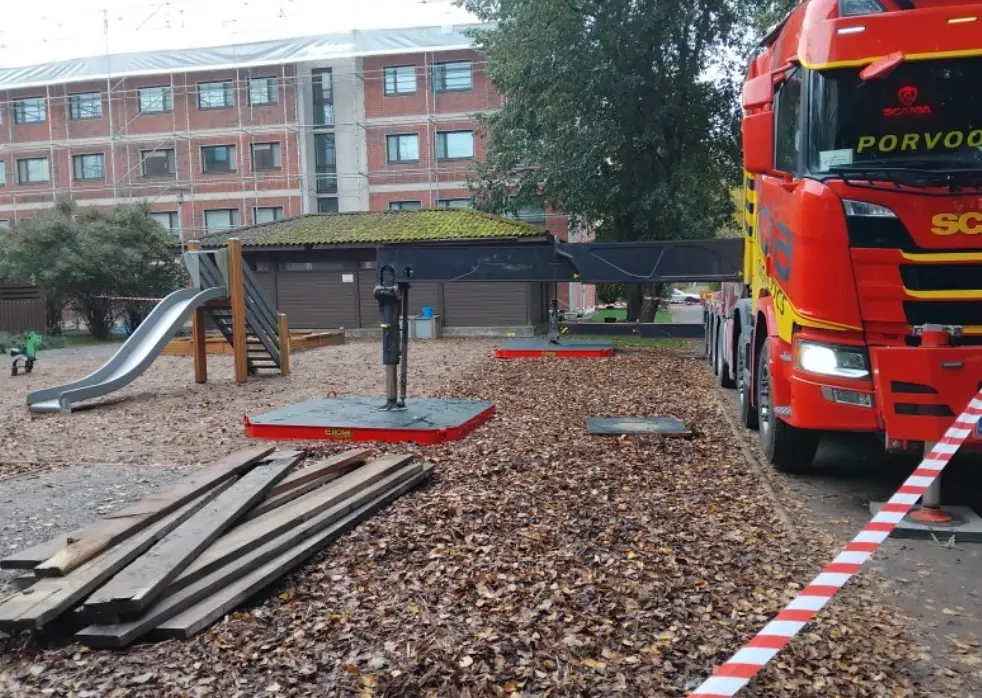
The crane truck shown in the article's photograph is set up on our largest support pontoons.
We have invested in different types of support equipment to ensure that lifting operations are not prevented by a lack of suitable equipment. When the bearing capacity of the supporting surface requires a larger-than-usual supporting area, the necessary crane support arrangements can be incorporated into the lifting plan from the beginning.
Sometimes a larger outrigger pad is sufficient. In other cases, a load-distribution structure or changes to the crane's positioning may be necessary. Certain situations also require a structural engineer to assess the load-bearing capacity of the supporting surface.
The essential point is that we understand the forces generated by the crane and the loads the supporting surface can withstand. In practice, safe crane support arrangements depend on sufficiently accurate information about outrigger loads, the support pads being used and the bearing capacity of the supporting structure or ground. Based on this information, the necessary measures can be determined.
Planning a crane setup is not simply about finding out where lifting is possible. It is also about determining what needs to be done to make lifting possible where it is needed.